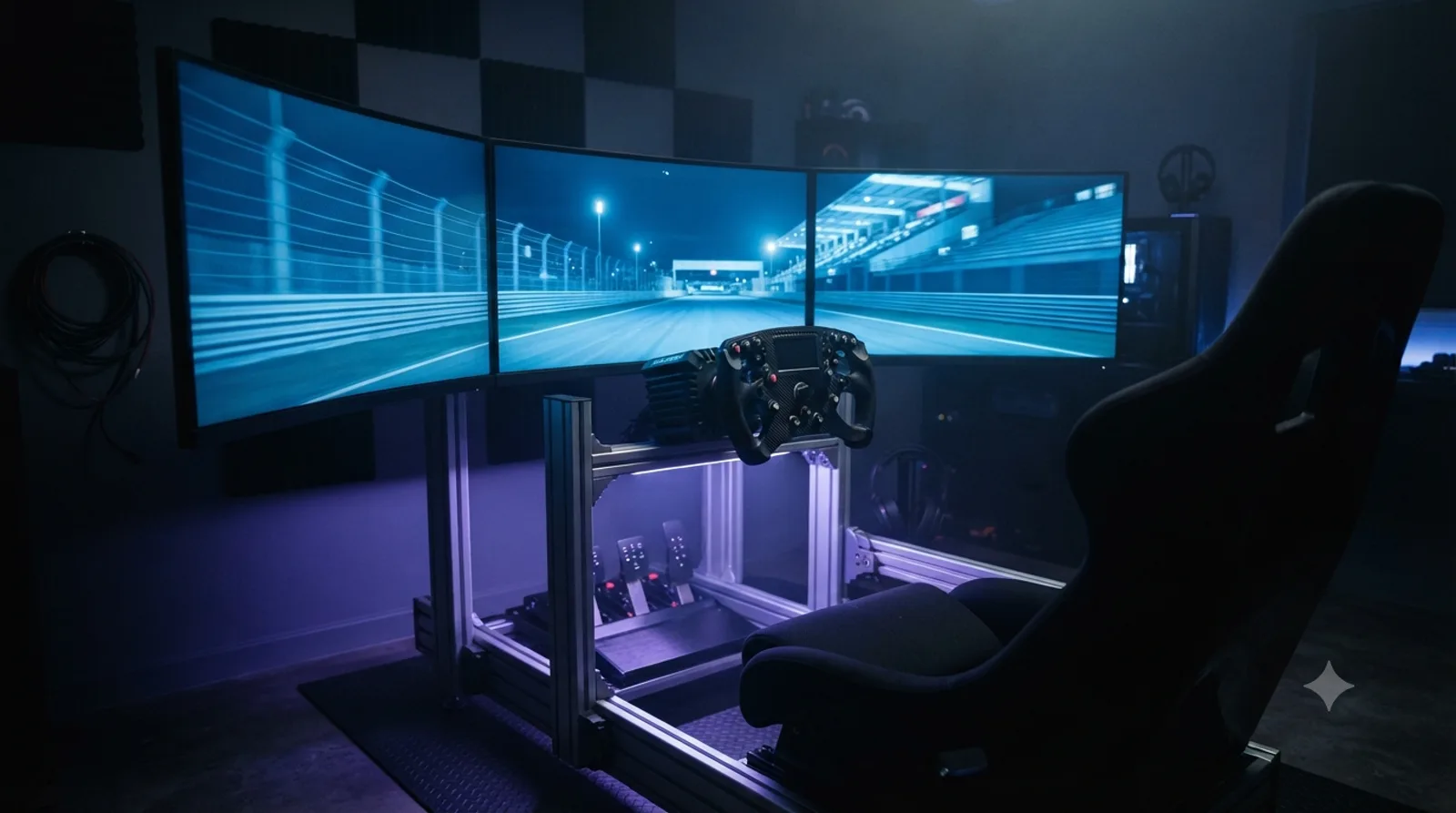
Sim Racing Hardware, Explained
Sim Gear Lab ranks sim racing hardware by the mechanism that actually decides how it feels and how fast you go — drive type, torque headroom vs resolution, load-cell force sensing, mount rigidity and platform licensing — not the number on the box. Three things most buying guides get backwards: more Nm does not mean more detail, the brake is the only pedal that needs a load cell, and the part you should upgrade first is almost never the wheelbase. No prices, no star ratings, an honest drawback on every pick.
The one thing to know: Torque is amplitude, not resolution. Detail comes from encoder count, cogging, slew rate and filtering — so a well-tuned 8 Nm base can out-inform a badly tuned 20 Nm one. Everything else on this site follows from that.
Start here — wheel, pedals, and something rigid to mount them to
Drive type sets the ceiling on wheel feel, but pedals are where most people find time: a load-cell brake is pressure-based, which is how real braking works. Mounting rigidity matters as much as either. Each links to a live Amazon search rather than a fixed listing.
Logitech G G923 TRUEFORCE Racing Wheel and Pedals
Dual-motor force feedback with TRUEFORCE, 900 degrees lock-to-lock, Hall-effect steering sensor, progressive-spring brake pedal; Xbox/PC or PlayStation/PC variants (Logitech publishes no torque figure)
The G29's successor: the same 900 degrees and three pedals, plus TRUEFORCE physics-driven feedback, closed-loop motor control, dual-clutch launch assist and an LED rev indicator in supported games.
Best for: Entry force feedback where your games support TRUEFORCE
Check price on AmazonNot deciding today? Add it to your cart over there — Amazon keeps it saved (and flags any price change) until you're ready.
Watch out: Every headline feature is a supported-games feature on Logitech's own sheet; in a title without TRUEFORCE it drives like a well-finished G29 with a better brake spring, still on travel-sensing pedals rather than a load cell.
Logitech G Driving Force Pedal Unit (G29 / G920 bundled set)
Potentiometer (travel-sensing) 3-pedal set; the baseline most people start on
The reference point a load-cell upgrade improves on: it senses how far the pedal moves, not how hard you press.
Best for: Understanding what you are upgrading from
Check price on AmazonNot deciding today? Add it to your cart over there — Amazon keeps it saved (and flags any price change) until you're ready.
Watch out: Travel-sensing potentiometers cap braking consistency and wear over time — your leg reproduces force far more repeatably than absolute position, which is the whole case for moving to a load cell.
Next Level Racing Wheel Stand Lite
Foldable tubular stand, collapses flat for storage; broad Logitech/Thrustmaster/Fanatec bolt patterns
The reason people pick a stand over a cockpit: it folds flat. Fine for apartment and console setups with gear- or belt-drive wheels.
Best for: Small spaces, belt/gear wheels, easy pack-away
Check price on AmazonNot deciding today? Add it to your cart over there — Amazon keeps it saved (and flags any price change) until you're ready.
Watch out: A light folding stand flexes and walks under braking — its failure mode is fore-aft rotation about the front feet — so it is out of its depth with mid-tier direct drive or a load-cell brake pushing against your seat.
Thrustmaster T3PM Magnetic Pedals
Magnetic contactless (Hall-effect) travel sensing; brake mod-kit stiffens via swappable inserts
Contactless magnetic sensors do not wear like potentiometers, and the mod-kit brake adds mechanical stiffness — a durability step up without load-cell pricing.
Best for: A step up from bundled plastic pedals that still senses travel
Check price on AmazonNot deciding today? Add it to your cart over there — Amazon keeps it saved (and flags any price change) until you're ready.
Watch out: Hall-effect is still position sensing, not force sensing — the brake feels firmer but you are not yet braking by pressure, so the consistency gain is smaller than a true load cell.
What do you actually need to start?
A wheel, pedals, and something rigid to bolt them to. The mount is not an afterthought — it is a series element in the force path, and a flexing desk or stand acts as a low-pass filter that removes exactly the high-frequency detail you paid the wheel for. Buy a wheel-and-pedal bundle if you are new, then upgrade the weakest link. For most people the weakest link is the pedals, then the mount, then the base — in that order.
Gear, belt or direct drive — what's the difference?
Drive type, not torque, is the first thing that decides how a wheel feels. Gear wheels are cheapest and grainiest; belt wheels are smoother but slightly dull; direct drive removes the reduction stage entirely, which is a fidelity upgrade rather than a strength one. The mechanism is covered in full on direct drive vs belt vs gear.
| Feature | Gear (e.g. G920/G29) | Belt (e.g. T300 RS) | Direct drive (e.g. G PRO) |
|---|---|---|---|
| Mechanism | Helical gear reduction | Toothed belt & pulley | Rim on the motor shaft, 1:1 |
| Typical torque | approx 2.2–3 Nm | approx 3–6 Nm | approx 3.9–32 Nm across tiers |
| Feel | Grainy; gear lash and tooth mesh | Smooth, quiet, slightly damped | Linear, no backlash; cogging at rest only |
| Detail resolution | Lowest — inertia scales with ratio² | Better, but compliance blurs the finest detail | Highest — no reduction stage to filter |
Where should the money go first?
Not the wheelbase. Pedals decide braking consistency, which is where lap time lives; mount rigidity decides whether you keep the detail your wheel produces; the base mostly buys immersion and limit-awareness. Here are entry wheels across the three drive types to show how tier maps to mechanism — but read what to upgrade first before spending.
Why isn't the premium gear on Amazon?
Because several premium brands sell direct or through authorised dealers only. Simucube, Asetek and Simagic have no first-party Amazon channel; most aluminium-profile rig hardware and Trak Racer's wheel stands are direct-order. Fanatec was direct-only for years and now runs an official Amazon storefront for CSL-tier products since the 2024 Corsair acquisition — but third-party Fanatec listings are often resellers, so check the seller identity, not just the listing. We never link direct-only brands to Amazon, and we say plainly where the gear actually comes from.
The guides
How Much Torque Do You Actually Need?
Torque is headroom against clipping, not detail. Why 5–8 Nm is enough for almost everyone, and what the extra Nm really buys.
Read →
Direct Drive vs Belt vs Gear
The mechanism, not the marketing. Reflected inertia scales with the SQUARE of the gear ratio — the fact that reframes the whole category.
Read →
Why Your Direct-Drive Wheel Feels Wrong
Notchy, weak, oscillating, vague on centre — four symptoms, one mechanism family (cogging, clipping, damping). Almost never a fault.
Read →
Load-Cell Pedals: What Actually Changes
Force sensing vs travel sensing, and why the brake is the only pedal that benefits. The highest-value upgrade most people make too late.
Read →
Do You Need a Rig? Mount Rigidity as Force Path
A flexing mount is a low-pass filter that deletes the detail you paid for. Stands, cockpits, desk clamps and how much torque each holds.
Read →
What to Upgrade First (Almost Never the Base)
Pedals, then mount rigidity, then wheelbase. The opinionated ordering framework, and why braking is where lap time lives.
Read →
The Torque Index
Every wheelbase we cover in one table: drive type, manufacturer-stated torque, rotation range and platform — with the manufacturer source cited on every row.
Read →
The Sim Racing Force Numbers
A normalized, versioned dataset of drive torque bands, torque tiers, load-cell ranges and mount clamp-torque ceilings — downloadable as CSV.
Read →
Best Direct Drive Wheel Base for Beginners?
The one-answer buyer page: which direct-drive base a first-timer should actually get, why platform licensing decides it, and the mount cost nobody budgets.
Read →
Do I Need Load Cell Pedals?
The straight answer on force vs travel sensing, which pedal actually benefits, and the load-cell sets worth searching for.
Read →
Best Wheel Stand for Direct Drive?
Which stands hold direct-drive torque, the ~12 Nm steel-tube ceiling, and why the top aluminium-profile stands aren't on Amazon at all.
Read →
Best Sim Racing Cockpit for Beginners?
The first fixed-seat cockpit on a tight budget, the fold-flat alternative, and why a fixed seating position is the consistency upgrade before rigidity is.
Read →
Gifts for Sim Racers
Setup-agnostic gifts that work without knowing their exact wheelbase — rig hardware, floor protection, and the accessory rail — not a wheelbase itself.
Read →
Frequently Asked Questions
A wheel, pedals, and something rigid to bolt them to. The mount is not an optional extra — it is a series element in the force path. A flexing desk or stand acts as a low-pass filter and removes exactly the high-frequency detail you paid the wheel for. So think of the setup as three linked parts, not a wheel with two afterthoughts. Start with a wheel-and-pedal bundle if you are new, then upgrade the weakest link, which for most people is the pedals, then the mount, then the base.
Pedals, then mount rigidity, then the wheelbase — almost always in that order. Braking is the highest-information channel a driver has, and travel-sensing bundled pedals cap your consistency regardless of how good the wheel is. A rigid mount comes next because adding torque to a flexing rig just makes the flex more obvious. The wheelbase is usually the last thing worth spending on, not the first, even though it is the part every marketing page pushes you toward buying biggest.
Better pedals and a rigid mount do, by improving braking consistency over a stint. A stronger wheelbase mostly improves immersion and your awareness of the car's limit, not raw lap time. Consistency comes from a repeatable braking reference and a stable seating position. A driver on a modest base with a load-cell brake on a rigid rig will generally beat the same driver on a flagship base clamped to a flexing desk. Torque is not where the lap time lives.
Several premium brands sell direct or through authorised dealers only. Simucube, Asetek and Simagic have no first-party Amazon channel; most aluminium-profile rig hardware and Trak Racer's wheel stands are direct-order too. Fanatec was direct-only for years and, since the 2024 Corsair acquisition, runs an official Amazon storefront carrying CSL-tier products — but plenty of third-party Fanatec listings are still resellers, so the check is the seller identity, not the mere presence of a listing. We never link direct-only brands to Amazon.
Footprint plus pedal travel in front, plus seat recline behind, plus screen distance ahead of that. A folding stand or fold-flat cockpit solves most bedroom and apartment cases, at the cost of some rigidity. Measure the fully-extended depth, not the folded size, before buying. Monitors should not share a frame with the wheelbase — force feedback shakes the image — so plan the screen mount as a separate structure from day one.
It can be, but not for the reason usually given. Direct drive means the rim bolts straight to the motor shaft, so there is no gearing to blur detail — it is a fidelity upgrade, not a strength upgrade, and 5 Nm direct-drive bases exist and feel gentle. The genuine costs are price and the rigid mount higher torque demands, not danger: strength is software-limited and every base ships with a low ceiling. If your budget forces a choice, better pedals usually beat a stronger base.
How we work
We are an explanation-first, research-based site: we analyse how the hardware works, manufacturer specifications, and the themes in named reviewers' feedback, rather than running our own test bench. Every subjective verdict is attributed, never asserted as our own measurement. We explain tradeoffs plainly, always name a downside, and quote only figures the underlying research supports.